BORACAY ISLAND, AKLAN

Boracay Island is a small island located in the Philippines located approximately 300 km south of Manila. Boracay Island and the beaches of the island has gained so much fame and even awards from many numerous travel publications and agencies.

BANAUE RICE TERRACES, IFUGAO

One of the major appeal of Banaue rice terraces to the local and international tourist are the many hiking trails in the area. There are many young locals, mostly college students who serve as guides. But with or without a guide, you will find the friendliness and warmth of the Ifugao people endearing.

MAYON VOLCANO, ALBAY

Classified as a stratovolcano (a volcano made up of layers of lava alternating with cinder and ash) Mount Mayon or Mayon Volcano is very much active and is located in the in the Bicol Region, in the province of Albay, on Luzon Island, Philippines.

CHOCOLATE HILLS, BOHOL

The most famous tourist spot of Bohol which marked the symbol of this Province is in the Municipality of Carmen. These unique landform known as “Chocolate Hills” was formed ages by the uplift of coral deposits and the action of rainwater erosion. The hills are scattered throughout the towns of Carmen, Sagbayan and Batuan, and consist of 1,268 of the same general shape.

TUBBATAHA REEF, SULU

The Tubbataha Reef Marine Park covers 130,028 ha, including the North and South Reefs. It is a unique example of an atoll reef with a very high density of marine species; the North Islet serving as a nesting site for birds and marine turtles. The site is an excellent example of a pristine coral reef with a spectacular 100-m perpendicular wall, extensive lagoons and two coral islands.

Showing posts with label tacloban. Show all posts

Friday, January 9, 2015

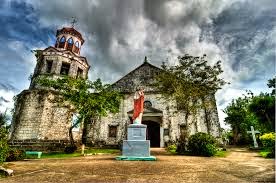
St. Michael the Archangel Church

ST. MICHAEL THE ARCHANGEL CHURCH
The hilltop Church of St. Michael the Archangel was said to have been built in the 17th century by Fr. Cristóbal Miralles.  It was burned and looted of its treasures on Corpus Christi Day during a slave raid in 1663. In 1845, it was repaired by Fr. Domingo de Madrid who also built a bell tower, a stone and coral convent, and a cemetery with a small chapel within.  It was damaged by a storm in 1880.  In 1894, Fr. Vicente Gutiérrez replaced the church roof with galvanized iron.

The convent, adjacent to the church, was the headquarters and hospital of the U.S. 9th Infantry around the time of the attack on Company “C” in Balangiga. A month later, the convent became the headquarters and hospital of a battalion of U.S. Marines under the command of Maj. Littleton W.T. Waller, which was attached to the Sixth Separate Brigade under Brig.-Gen. Jacob H. Smith. This Marine battalion was tasked with turning southern Samar into a “howling wilderness.”  During the Liberation, it was used as an evacuation center by Leyteños.

Sto. Nino Shrine and Heritage Museum

STO. NINO SHRINE AND HERITAGE MESEUM
At first this attraction doesn't seem like much more than a tiny shrine you can see from the entrance but once you go inside and begin your tour you will learn that it is much more than that. 

The heritage museum part of the old Marcos/Romuldez ancestral home is exquisite. Built by controversial former Philippine President Ferdinand Marcos and his wife Ismelda, this home is filled with treasures from all around the world. The tour takes you through the guest rooms surrounding the shrine downstairs as well as the family living quarters upstairs. Mementos/artifacts range from a chair the pope sat in when he visited Tacloban to a huge collection of Ming vases and ivory carvings from China. The museum is a testament to the lavish lifestyle of the Marcos' family before their exile to the United States. This hidden treasure in Tacloban is definitely worth visiting.

The Santo Niño Shrine, one of the 29 presidential rest houses that the late Pres. Ferdinand Marcos had built. There is an Olympic sized swimming pool the behind the building. 

The entrance to the Santo Niño Shrine. The Santo Niño is at the far end of the entrance. On both sides are a number of guest rooms with various themes. 

Santo Niño, a representation of the infant Jesus Christ, is the patron saint of Leyte.

It is located in Real Street, Tacloban City. Paintings of the 14 stations of the Cross done by Filipino artists, wooden bas-relief of the legend of the First Filipino man-woman (Si Malakas at si Maganda); tastefully decorated guestrooms of varied Filipino motifs; image of the Holy Child; a collection of original paintings by Fernando Amorsolo; spacious ballroom; priceless. collector's.

San Juanico Bridge

SAN JUANICO BRIDGE

This huge bridge is unique in the Philippines by its size, beauty and usefulness. It cannot be missed when you cross over from Samar island to Leyte island and avoids you the crossing of treacherous waters with high current. One sections rises very high so that large size ships can pass under and allows the large unsupported part its structural strength.

The San Juanico Bridge is the longest bridge in the Philippines, with a length of 2 km. It crosses the San Juanico Strait, bridging the islands of Samar and Leyte. It is also known as the Marcos Bridge, it is said to have been presented as a Gift and "Testimonial of Love" by the Philippine President Ferdinand Marcos to the first lady, Imelda, a native of Leyte.

It connects Tacloban City on the Leyte side and Santa Rita town on the Samar side. It offers many picturesque views, especially of the San Juanico Strait with its thousand whirlpools as well as the islets of the province. It is the narrowest strait in the Philippines & separates the islands of Samar and Leyte. At its narrowest point, the strait is only 2 km wide.  

It is approximately 10 minutes from downtown Tacloban City and is accessible by passenger jeepney, bus, motorcab or private vehicle. Construction on the $21.9 million Bridge was started in 1969 and completed four years later.